
[Ed. Note – The exploits of the U.S. Navy during the American Civil War have long been overshadowed by the skirmishes and battles on land. Blockade duty may well have been less glamorous than the land campaigns, but it was just as, if not more, crucial to the success of General Scott’s overall plan to interdict supplies flowing to the Confederacy.
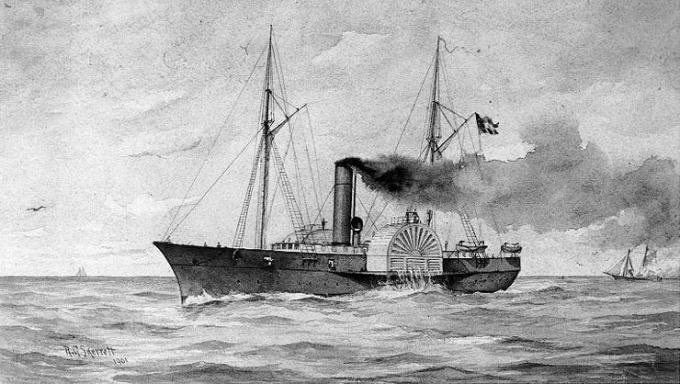
The USS Wissahickon was a 691-ton Unadilla class screw steam gunboat built at Philadelphia, Pennsylvania. She initially served in the Gulf of Mexico and on the Mississippi River where she was instrumental in the capture of New Orleans. She made two runs past the Confederate fortifications at Vicksburg and engaged in a battle with the ironclad CSS Arkansas. After repairs at Philadelphia late in 1862, Wissahickon joined the blockade of the coasts of South Carolina, Georgia and eastern Florida. In addition to her actions surrounding Fort McAllister and the burning of the CSS Nashville (formerly the privateer Rattlesnake) during the summer of 1863 she bombarded Forts Wagner and Sumter, off Charleston, South Carolina. Alfred Thayer Mahan, one of the greatest naval strategist and historians was her commander for a brief period in 1864.
Fort McAllister was an earthwork fort built on the McAllister plantation southeast of Savannah and protected the approaches to the city up the Ogeechee river. Despite the quick reduction of the masonry-built Fort Pulaski further down the river, Fort McAllister resisted seven different attempts by the Union fleet to reduce the earthen bastions. McAllister stood until taken from the rear by General Sherman’s army in 1864.]
Boston Post & Statesman
P.2; c. 5
Letter from Georgia.
Correspondence of the Boston Post.
U.S. Steam Gun-Boat “Wissahickon”
Off Ossabaw Sound, Georgia,
Wednesday, 4th of March, 1863
Fort McAlister would seem to be destined to as prominent a position in the present rebellion as was Fort Moultrie in the old revolutionary time. One cannot but express admiration at the plucky and gallant defense which its garrison has made in several recent attacks. So far they have successfully resisted all our attempts to silence and take possession of the fort, and the question has been asked, how much probability is there of the forthcoming attack upon Charleston being successful, if one little sand-battery can withstand the efforts of our iron-clads? That McAlister will be taken I do not doubt, for it has become a point of honor to take it, and take it we must and shall. Last Saturday I sent you a brief and hurried account of the destruction of the “Nashville.” I have since learned her destination was Nassau. The following extract from a letter I have seen will explain what was the intended nature of her cruise: — “the Nashville’ was expected every hour at Nassau, it being rumored that she had discharged her cotton and was fully iron-clad, ready to run the blockade.” Supplies, recruits and the remainder of her armament awaited her ether, and had she succeeded in escaping she would have proved no less formidable upon the seas than the “Alabama,” for her speed is well known – indeed she had the reputation of being the fastest steamer sailing out of the United States. When the very great difficulty of keeping one of these fast steamers in is taken into consideration, as proved in the cases of the “Sumpter,” “Alabama” and “Florida,” I think considerable credit attaches to the three or four vessels whose untiring vigilance along prevented the escape of this much to be dreaded privateer. The “Wisahickon” was sent down to the Ossabaw station in October of last year, where she has since remained, with the exception of a single fortnight spent in refitting and repairing at Port Royal, and during which fortnight the only evasion of the blockade which has occurred since we were appointed to the station took place – a small schooner, taking advantage of the increased chances of escape afforded by our absence, getting out by the north passage. During the greater part of this time our commanding officer, Lieut. Commander John L. Davis, has been the senior officer on the station, and it is in no small degree owing to his energetic efforts, and the assistance of his executive officer, Lieut. Silas Casey, that we are able to present so fair a record. The “Wissahickon” has taken part in four attacks upon Fort McAlister, besides having been under the fire of the fort in two other instances, one of them being the occasion in which the “Nashville” was destroyed, that vessel laying under the guns of the fort, obliging us to go within range of the guns of the fort to get at her. We were once nearly sunk by a plunging shot from their largest gun, which hit us five feet below the water line, obliging us to beach the vessel for repairs. On this occasion the “Wissahickon” was acting as flag-ship in an attack upon the fort. We have also, assisted by the “Dawn,” obliged the Confederates to burn a schooner to prevent her falling into our hands, we having attacked her as she lay at anchor under the guns of their battery on Coffee Bluff, loaded with cotton and turpentine, waiting an opportunity to sail in hourly anticipation of an attack upon us by the iron-clad “ram.” Atlanta, formerly the “Fingal.” In the last attack, upon Fort McAlister we acted as signal-ship for the iron-clads, being the farthest up of any of the wooden vessels towards the fort, coming next to the iron-clads, and were the only wooden ship under fire, with the exception of the mortar schooners.
We are now on our way to Port Royal to take in provisions and coal, preparatory to joining the fleet off Charleston. We should have preferred to have remained at Ossabaw until the stars and bars on Fort McAlister had been lowered to make way for the old flag, and we regret that we are not to be permitted to be in at the death. But honor awaits the brave everywhere, and we hope to be permitted to make our mark at Charleston.

I am, very respectfully, &c., yours,
“K.”
 Since Last I Wrote You, Mr. Editor;